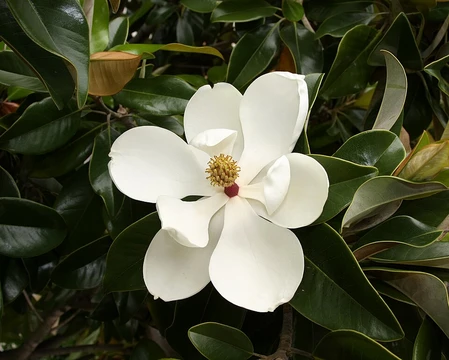
Forest
Where a single petal first learns the language of the wind.

The Forest is the opening biome of *Flower* (2009), the meditative platformer developed by thatgamecompany and directed by Jenova Chen. In this lush, painterly woodland the player first takes control of a single fallen petal, learning to ride gusts of wind through a canopy of swaying trees, drifting grass, and scattered blossoms. It establishes the game's core loop—being carried by the wind, collecting loose petals to grow, and flowing forward—before the journey opens into the game's later, more expansive environments.
Because it is the player's first experience in the world, the Forest is deliberately gentle and enclosed. The overhead canopy frames the play space, the wind patterns are forgiving, and the visual palette stays in soft greens and warm dappled light, giving new players a low-pressure introduction to the game's physics and its wordless, music-driven narrative.
- Game
- Flower (2009)
- Developer
- thatgamecompany
- Director
- Jenova Chen
- Platform
- PlayStation 3
- Role in game
- First / starting biome
- Art style
- Painterly, watercolor-inspired
- Primary mechanic
- Wind-driven petal traversal
Lore & Background
In the wordless narrative of *Flower*, the petal the player controls is one of many that have drifted from a great bloom. The Forest is where that journey begins: a shaded, living corridor of trunks and leaves through which the wind still carries the scent of the original flower. The dense canopy overhead acts almost like a second sky, filtering the light into shifting patches of gold and green and giving the space a hushed, cathedral-like quality.
As the petal moves deeper, the forest thins. Clumps of grass part to reveal small meadows of loose petals waiting to be gathered, and the wind shifts from gentle eddies to longer, more purposeful gusts that pull the player forward. There is no antagonist in this section; the only tension is the quiet pull of the breeze versus the petal's own weight, and the satisfaction of growing a little larger with every blossom collected.
The Forest's role in the broader story is one of origin and trust. It teaches the player that the world of *Flower* is not a place to be conquered but one to be passed through, carried by forces larger than the petal itself. By the time the canopy gives way and the horizon opens into the game's later biomes, the player has internalized a simple, almost spiritual rhythm: release, drift, gather, repeat.
In Their Own Story
The wind finds you before you find it. One moment you are a pale, curled scrap of petal resting in a tangle of grass; the next a long exhalation from somewhere above the canopy lifts you, and you are tumbling, spinning, pressing your thin edge against the underside of a broad leaf. You are not flying. You are being *carried*. Below, the forest floor is a wash of moss-green and the faint amber of dappled sun. Another petal drifts past, barely a whisper of color, and you reach for it with a motion that is less a command and more a sigh. It catches. You are a little bigger now. The gust strengthens, the trunks blur into ribs of brown and gold, and the forest—patient, breathing, indifferent—lets you go.
Reader's Guide
The Forest reads as a continuous, gently winding corridor rather than a series of discrete rooms. Its visual identity is built on layered depth: a foreground of swaying grass blades and scattered wildflowers, a midground of slender trunks and low shrubs, and an overhead canopy that frames the top third of the screen in dense, leafy shadow. The palette stays in soft greens, warm ochres, and the occasional pop of pink or white blossom.
The primary interactive element is the wind. Gusts arrive from the left and push the petal forward; the player's input (a tap or hold on the analog stick) tilts the petal to catch or shed the current. Loose petals dot the path and, when collected, add to the player's size and create a brief trail of smaller petals that follow behind. There are no enemies, no timers, and no fail states—only the rhythm of drift and gather.
As the Forest section progresses, the canopy gradually thins. Early stretches feel enclosed, with branches crossing overhead and the play space narrow. Later stretches open into small clearings where the wind runs in longer, straighter lines and the petal can travel faster. The grass becomes sparser, the trees more widely spaced, and the light shifts from filtered gold to a brighter, more direct wash—signaling the transition toward the game's next biome.
There are no hidden collectibles or secret rooms in the traditional sense. The closest thing to a "secret" is the game's wordless storytelling: the petal's growing size and the accumulating trail of smaller petals behind it are the only narrative markers, reinforcing the idea that the Forest is a place of beginning and accumulation rather than discovery.
Did You Know?
- Flower contains no traditional text, dialogue, or on-screen instructions; the Forest is learned entirely through the feel of the wind and the petal's physics.
- The game's art direction was built around a painterly, watercolor aesthetic, and the Forest's layered canopy was designed to give the 3D space a flat, illustrated depth that reads almost like a moving painting.
- thatgamecompany, Flower's developer, is also known for the later title *Journey* (2012), which shares the studio's emphasis on wordless, emotionally driven design.
- The petal the player controls has no name, no backstory beyond its journey, and no dialogue—its identity is defined entirely by the act of being carried and growing.
More in Biomes & Arenas
Elsewhere in the Flower universe
Spotted an error? Know more?
This is a living reference — every entry is fact-audited, and reader corrections feed straight into our audit queue. Suggest an edit · See this site's audit record