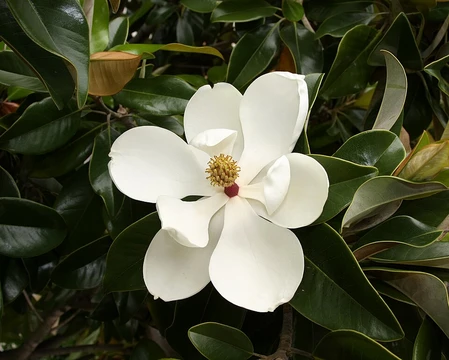
Valley
A single petal's quiet journey breathes color back into a sleeping valley.

The Valley is the entire playable world of *Flower* (2009), the atmospheric adventure game developed by thatgamecompany for the PlayStation 3. Rather than a collection of discrete arenas, the Valley is one long, gently curving corridor of land that the player traverses from one end to the other as a single petal carried on the wind. It functions simultaneously as a landscape, a puzzle space, and a living character: the terrain, vegetation, and color palette all respond to how much life the player has gathered along the way.
In the game's narrative framing, the Valley has fallen into a muted, gray, half-dead state. The player's journey—collecting loose petals, stirring the air, and passing through dormant trees—slowly reawakens the environment, turning rust and ash back into green, gold, and violet. The Valley is therefore not a static arena but a reactive stage whose visual identity shifts in direct proportion to the player's progress.
- Developer
- thatgamecompany
- Platform
- PlayStation 3
- Release year
- 2009
- Player role
- A petal carried by the wind
- Core mechanic
- Wind manipulation and petal collection
- Structure
- Single continuous linear valley
- Combat
- None
Lore & Background
The Valley was not always the pale, industrial husk the player first encounters. In the game's implied history, the land was lush and wind-swept, home to trees that shed their petals in great spiraling clouds. At some point the air grew still, the streams slowed, and a grey industrial presence—fans, ducts, and rusted structures—crept into the landscape, choking the natural cycle. The Valley did not die so much as fall asleep, waiting for a breath strong enough to wake it.
The player's petal is that breath. There is no antagonist, no villain to defeat; the Valley's dormancy is the sole obstacle. Every gust the player generates, every petal gathered from the ground or shaken from a branch, is a small act of re-animation. The trees along the path respond by releasing their own stored petals, the stream quickens, and the sky shifts from overcast grey to warm, saturated light. The Valley's 'story' is told entirely through its changing appearance: rust peels away, moss returns, and by the final stretch the land is almost unrecognizable from its opening state.
thatgamecompany designed the Valley as a single, unbroken space with no loading screens, no menus interrupting the flow, and no traditional objectives beyond forward motion and collection. The emotional arc is one of gentle restoration rather than conquest, and the Valley itself is the only 'character' the player ever truly interacts with.
In Their Own Story
The petal lifted off the grey gravel with a breath the player barely noticed. Ahead, the valley floor was a smear of rust and ash, and the great iron fans at the far end groaned in their slow, mechanical rhythm. The stream ran thin and brown, barely a whisper between the rocks.
A gust—just a flick of the controller—sent the petal skimming across the dead grass. It caught an updraft, spiraled, and passed through the canopy of a bare tree. Leaves, dry and papery, peeled away and tumbled down in a slow spiral. The petal tucked them in, and for a moment the air smelled of something green.
By the time the valley opened into its wider middle stretch, the stream had thickened to a proper ribbon of water, and the fans had slowed to a lazy hum. The sky, which had been the color of old paper, now held a faint violet at the edges. The petal did not notice any of this. It only knew the pull of the wind and the quiet, persistent need to keep moving forward, gathering, stirring, until the valley remembered what it was.
Reader's Guide
The Valley opens in a narrow, grey corridor dominated by industrial structures: large rotating fans, exposed ducts, and rusted metal that the player must navigate around or through. The ground is barren gravel and dead grass. The primary hazard here is the fans' strong, directional wind, which can push the petal off course or trap it in a loop. The player must time gusts to thread between blades.
Moving forward, the valley widens into a more natural middle section. A slow stream runs alongside the path, and dormant trees line both banks. Passing through a tree's canopy shakes loose stored petals, which the player can collect. The ground softens to dirt and sparse grass. Wind tunnels and updrafts replace the mechanical fans as the main interactive elements, requiring the player to build momentum through a series of gusts to clear gaps or reach elevated petal clusters.
As the player's collected petal count grows, the Valley visibly transforms: rust fades, the stream quickens and deepens in color, trees flush with green and gold, and the sky shifts from flat grey to warm, layered light. The final stretch is open, sunlit, and dense with vegetation. There are no new hazards in the later sections; the challenge is purely rhythmic—maintaining a steady flow of wind through increasingly complex updraft patterns while collecting the last scattered petals.
Lore secrets are environmental rather than textual: the Valley's transition from grey to color is the entire narrative. Watching the fans slow and the stream bloom is the game's way of telling the player that the land is remembering itself.
Did You Know?
- The entire Valley is one continuous, unbroken level with no loading screens or menu interruptions from start to finish.
- There is no combat, no enemies, and no traditional scoring system; the player's only 'score' is the growing flower they carry.
- The Valley's visual state—color, vegetation density, and sky tone—changes in real time based on how many petals the player has collected, meaning two playthroughs can look noticeably different.
- The game was designed by Jenova Chen, who later co-founded thatgamecompany's follow-up title Journey.
More in Biomes & Arenas
Elsewhere in the Flower universe
Spotted an error? Know more?
This is a living reference — every entry is fact-audited, and reader corrections feed straight into our audit queue. Suggest an edit · See this site's audit record